



 20 / 106

Commitments for a
sustainable business
Carrefour’s retail activities andeconomicmodel
are closely linked to theavailability andcapacity
for renewal of natural resources, aswell as thequality
andquantity of agricultural production. TheGroup
integrates these challenges into its activities,
andstructures its actionaround threepriorities:
protectingbiodiversity, combatingwasteand
supporting itspartners ina responsibleapproach.
Saving energy in stores
As an official partner of the United Nations Conference on Climate
Change (COP21), held in Paris in 2015, Carrefour has set itself
an ambitious goal: to reduce its CO
2
emissions by 40% by 2025
versus 2010. This is part of a longer-term goal of achieving a 70%
reductionby2050.
To accomplish this, the Group is focusing on reducing the energy
consumption of its stores and warehouses by 30%. This search for
energy efficiency includes, among other things, the installation of
low-energylighting,givingprioritytonaturallight,makinguseofless
energy-intensive facilities, and sensors tomore accuratelymeasure
thevariousconsumptionsources.Since2010,Carrefourhasalready
reducedenergyconsumptioninitsstoresworldwideby12%
(1)
.
(1) Per sq. m. of sales area.
Preserving biodiversity
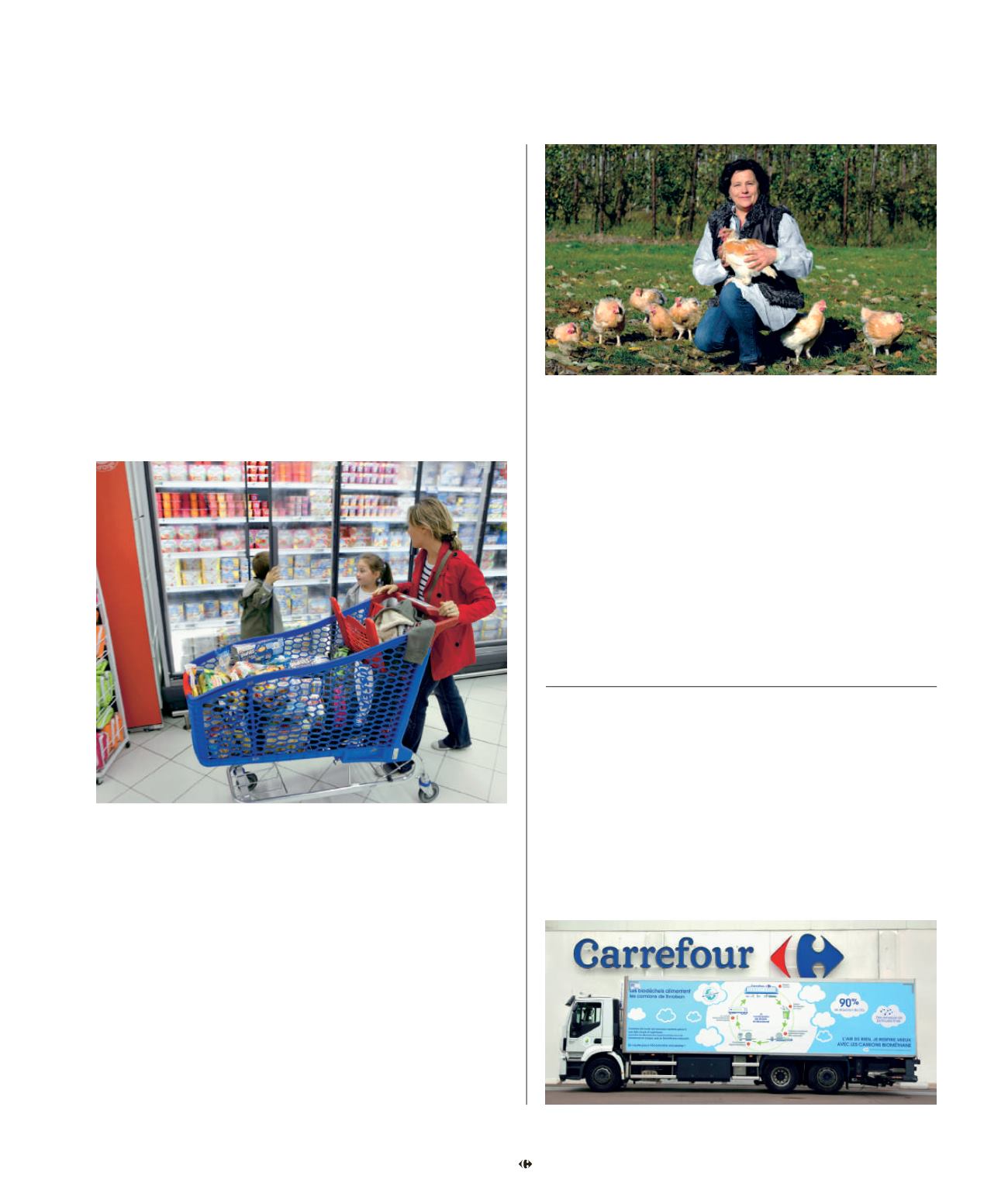
Carrefour plays an active role in initiatives to reduce the environ-
mental footprint of its activities and encourages its customers
to consume responsibly. The Group is therefore committed to
enhancing agroecology through the Carrefour Quality Lines,
by developing agricultural practices that pay greater respect
to natural cycles and limit the use of pesticides, antibiotics, etc..
It is also expanding its offering of products from organic agri-
culture to sustainable fishing, as well as products that do not
cause deforestation. In conjunction with all stakeholders,
the Group is supporting the goal of zero deforestation by 2020.
To this end, 100% of the palm oil used in Carrefour-brand
products now comes from controlled sources supported by
theRoundtableonSustainablePalmOil(RSPO).
Rethinking transport
Carrefour intends to reduce its CO
2
emissions linked to transport
by 30%by 2025. To accomplish this, the Group is rethinking its
logisticsmodels in order to reduce the distances between ware-
housesandstores, tooptimise lorry loading rates, and toencour-
age the use of return journeys with suppliers. Carrefour is also
seeking to develop alternatives to the use of diesel by employing
hybrid vehicles and deploying a fleet of 200 lorries running on
biomethane inFrance, aswell as offering customers inShanghai
electricshuttles.
LEADERSHIP AND AGILITY
20 UNIQUE AND MULTIPLE
/ 2015 ANNUAL ACTIVITY AND RESPONSIBLE COMMITMENT REPORT